



HMO EICR booking in London usually needs earlier planning than a standard rental EICR. HMOs have more occupants, heavier circuit use, and stricter licensing checks, so inspections take longer and require an electrician experienced in multi-occupancy rules. Standard rentals are often simpler, with fewer circuits and easier access. Landlords of both must plan around access, paperwork, and any remedial work. The key differences become clearer when the process and timing are compared in more detail.
Key Takeaways
- HMO EICR bookings in London are more complex than standard rentals due to multiple occupants, higher circuit loads, and stricter multi-occupancy safety regulations.
- Both HMO and standard rentals legally require EICRs at least every five years, but HMOs should be booked months early to allow for remedial works.
- Choose an electrician experienced specifically in HMO regulations and multi-occupancy wiring, not just general rental EICRs, to ensure compliance with London council licensing.
- Arrange HMO access carefully by coordinating with all tenants, offering flexible time slots, and ensuring every locked bedroom and common area can be inspected.
- Standard rental EICR bookings are usually quicker, with simpler circuits and fewer rooms, and can often be aligned with void periods or refurbishment works.
Table of Contents
HMO EICR Booking vs Standard Rental Booking
Although both aim to verify electrical safety, HMO EICR booking in the UK differs from standard rental booking in scope, urgency, and regulatory scrutiny. In an HMO, multiple unrelated occupants, higher usage of circuits, and dense occupation patterns raise the electrical risk profile. As a result, inspectors typically spend longer on site, test more circuits, and probe deeper into previous alterations, loading, and protective devices.
Standard rental bookings usually involve a single household and simpler wiring arrangements. While they still require competent inspection, the assessment is often more straightforward, with fewer high‑demand communal areas and less intensive wear on installations. For HMO owners who value flexibility and minimal interference in their operations, understanding these differences matters. HMO EICR booking demands stricter coordination with qualified contractors, clearer documentation, and greater readiness for remedial work, while standard rental EICRs tend to be lighter‑touch, with fewer regulatory levers pressing for rapid follow‑up.

When Should an HMO EICR Be Booked?
Knowing when to book an HMO EICR in the UK hinges on both legal minimums and practical risk management. For most licensed HMOs, the inspection must be carried out at least every five years, or sooner if the previous report recommends a shorter interval. Responsible landlords tend to schedule the next EICR several months before expiry, keeping space to resolve any issues without rushing or restricting tenants’ freedom.
An HMO EICR should also be booked whenever there is a significant change to the electrical installation or occupancy pattern. Examples include reconfiguring rooms, adding high‑load appliances, converting additional spaces into bedrooms, or after any electrical fire, flooding, or visible damage. Booking is also prudent when taking over a new HMO, even if paperwork appears in order, to avoid inheriting hidden risks. Proactive timing protects tenants’ autonomy, minimises disruption, and keeps the property compliant without last‑minute pressure.
When Should a Rental EICR Be Booked?
When should a rental EICR be booked in the UK, beyond the bare legal minimum? A landlord who values flexibility and low‑stress management will not wait for the five‑year deadline or a change of tenancy to act. Instead, they typically treat the EICR as a rhythm that keeps their property independent of crises and last‑minute constraints.
Outside the statutory cycle, an EICR is sensibly booked when taking on a new property, after significant electrical work, or whenever there are signs of strain: frequent tripping, overheating accessories, visible damage, or DIY alterations.
Many landlords also choose a mid‑cycle check, around year two or three, especially in older buildings or where loads are high (electric heating, EV chargers, multiple appliances). Timing is also guided by practical freedom: aligning inspections with void periods, planned refurbishments, or rent reviews reduces disruption, keeps options open, and allows upgrades to be made on the landlord’s terms, not under emergency pressure. Are you going to let your property? Read the blog post Do I Need an EICR Before Renting? Do I Need an EICR Before Renting Out My London Property?
Choosing an EICR Provider for an HMO
Thoughtful timing is only part of low‑stress HMO management; who carries out the EICR matters just as much as when it is booked. For HMOs, the provider must be a qualified, competent electrician familiar with multi‑occupancy regulations and local authority expectations in London. This allows owners to protect their flexibility and avoid surprise enforcement action.
An ideal provider demonstrates clear experience with HMOs specifically, not just standard rentals. They explain findings plainly, outline options rather than pushing the most expensive fix, and work around tenants’ routines to minimise disruption. Transparent pricing, written quotes, and clear scopes prevent creeping costs that erode a landlord’s sense of control.
Public reviews, professional memberships, and evidence of insurance help verify reliability. Providers who keep digital records, issue promptly accessible reports, and offer timely remedial work enable landlords to stay compliant with minimal friction, keeping the property safe while preserving personal time and freedom. Explore Can Any Electrician Issue an EICR Certificate in London?
Providing Property Details When Booking
Before an electrician can quote accurately or plan the visit, the landlord must supply clear, specific details about the HMO. This information lets both parties avoid rigid assumptions, price shocks, and rushed decisions on the day of inspection. Unlike standard single‑let rentals, an HMO’s complexity demands a sharper description of the electrical layout and risk profile.
Key details typically requested include:
- Number of storeys, bedrooms, and communal areas, plus any outbuildings or annexes
- Age and type of installation, including consumer units, visible DIY work, and prior EICRs
- Presence of electric showers, panel heaters, off‑peak circuits, or EV charging points
- Known faults, tripping circuits, damaged accessories, or recent electrical incidents
Arranging Access for Multiple Occupants
Although the electrical inspection itself is straightforward, arranging access in an HMO is often the hardest logistical step. Each room may be someone’s private sanctuary, with different routines, work patterns, and privacy expectations. Coordinating an electrician’s visit without disrupting that sense of independence requires structure that still respects autonomy.
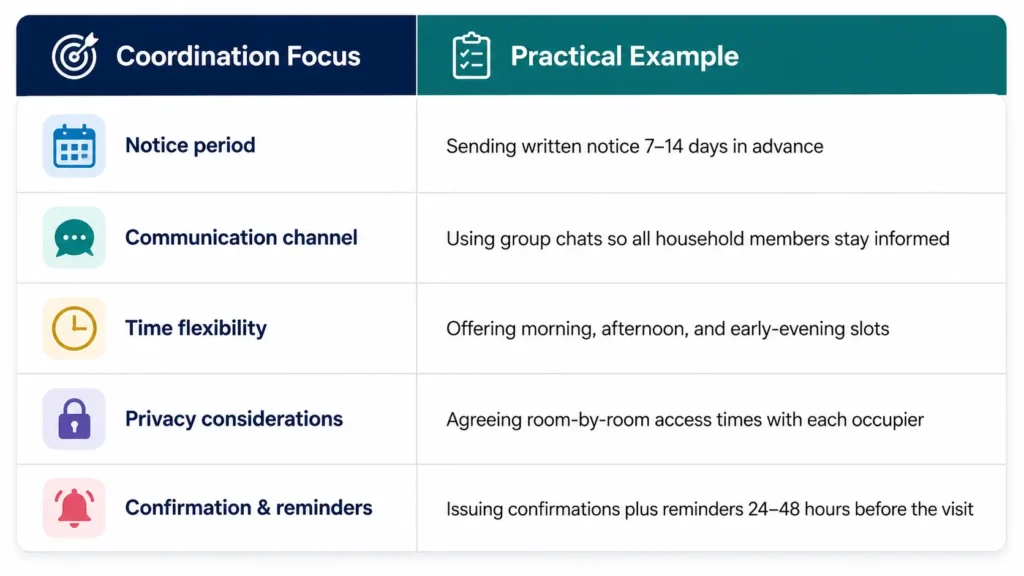
Owners or managers typically begin by securing consent-focused contact details for every occupant and offering several time windows, rather than imposing a single slot. Clear notice is essential, but so is flexibility: evening or weekend options, split visits across days, or staggered room access can reduce resistance and missed appointments.
Many find it effective to agree on a “lead contact” within the household who helps align everyone’s availability, while still allowing individuals to opt for alternative times. Digital tools, group messaging, booking links, reminders, let occupants manage their own schedules, making compliance feel less like control and more like coordinated cooperation.
Booking Access to Communal Areas
Securing access to communal areas for an HMO EICR often demands a different approach from arranging entry to individual rooms. Hallways, stairwells, shared kitchens, lounges, and plant rooms must be accessible without unnecessarily constraining residents’ daily routines. The inspection company typically requests clear information on which communal zones exist, how they are secured, and when they are usually in use.
To keep the process efficient yet minimally intrusive, owners and managers often clarify in advance:
- Which doors, riser cupboards, and meter rooms must be accessed, and by whom
- How fire alarm panels, emergency lighting controls, and consumer units can be safely reached
- What temporary measures maintain safe circulation while testing is underway
- How to balance safety signage and cordoned-off areas with residents’ right to move freely
A well-planned booking for communal access allows the electrician to work methodically while keeping shared spaces open, safe, and functional.
Coordinating EICR Appointments With Tenants
When arranging EICR appointments in an HMO, effective coordination with tenants is essential to gain timely access without disrupting daily routines. Landlords and managers in London typically begin by offering wide appointment windows, then narrowing them once the electrician’s schedule is confirmed. Clear written notice respects tenants’ autonomy while meeting legal access requirements.
Tenants value options. Flexible slots, weekend availability, and the chance to choose from several proposed times reduce friction and last‑minute refusals. Digital tools such as email, WhatsApp groups, or online booking links allow occupants to respond when it suits them, rather than being pinned to a phone call. Here is the guide if Tenant Not Available for EICR: How to Rearrange Quickly.
What Can Delay an HMO EICR Booking?
Why do some HMO EICR bookings progress smoothly while others stall for weeks? Delays often arise before an electrician even steps through the door. In HMOs, layers of regulation, higher occupancy, and complex ownership structures can all slow the process, limiting a landlord’s freedom to move quickly.
Typical blockers include:
- Limited HMO‑competent electricians: Fewer contractors are qualified or insured for large multi‑let properties, stretching lead times.
- Licensing and documentation checks: Councils or managing agents may require licence details, previous reports, and layout plans before confirming works.
- Complex electrical installations: Multiple consumer units, communal circuits, and add‑on extensions often require longer time slots, reducing available dates.
- Access to common areas and plant rooms: Even when rooms are accessible, locked meter cupboards, basements, or roof spaces can force rescheduling.
Understanding these HMO‑specific friction points lets owners plan earlier, secure flexible dates, and keep regulatory pressure from turning into lost time and unnecessary constraints.
What Can Delay a Rental EICR Booking?
Many routine rental EICR bookings stall long before testing begins, and the causes are often administrative rather than technical. Landlords frequently face delays when letting agents, tenants, and electricians cannot align diaries, especially where access is restricted by managing agents or concierge systems. Waiting for free slots with a preferred contractor can also push inspections back for weeks.
Paperwork slows things further. Missing tenancy details, incomplete property addresses, or uncertainty over who is legally responsible for commissioning and paying for the report can freeze progress. Some landlords shop around for quotes for too long, losing available appointment windows in the process.
In blocks of flats, freeholder or managing-agent approval may be required before an electrician can touch communal intake points, adding another layer of permission and email traffic. Finally, confusion between local authority licensing demands and national regulations can cause hesitant decision‑making that postpones firm booking dates. Check out Booking an EICR Certificate: Quick Landlord Guide to Booking an EICR Certificate in 2026.

Preparing the Property Before Booking
Administrative hold‑ups are only part of the story; the condition and readiness of the property itself often determine how smoothly an HMO EICR booking proceeds. Before committing to a date, a landlord who values flexibility and minimal disruption guarantees the space is genuinely inspection‑ready. This avoids repeat visits, rushed decisions, and unnecessary constraints on how the property can be used.
Key preparation steps typically include:
- Guaranteeing all rooms, including individual lettable units, are opened and safely accessible, with clear routes to consumer units and key circuits.
- Removing obstacles around sockets, distribution boards, and fixed appliances so testing can be completed without moving tenants’ belongings.
- Checking that previous DIY alterations are documented, and any loose accessories, damaged fittings, or missing covers are addressed in advance.
- Confirming tenants are informed about the visit, understand the purpose, and have arranged presence or access, maintaining their autonomy while enabling full inspection.
Which EICR Booking Is More Complex?
Curiously, not all HMO EICR bookings present the same level of difficulty, and complexity often hinges less on size than on layout, occupancy, and history. In London, multi‑let properties tend to be more intricate than standard single‑tenancy rentals because each locked room effectively functions as a mini‑dwelling, with layers of circuits, protectors, and usage patterns to verify. Access to every room, at the same time, is rarely simple.
| Booking Type | Typical Complexity Drivers | Impact on Freedom of Use |
| HMO EICR Booking | Multiple occupants, lockable rooms, alterations | More coordination, stricter controls |
| Standard Rental EICR | Single tenancy, simpler circuits | Faster checks, fewer disruptions |
| Large HMO EICR | Extended circuitry, mixed old/new wiring | Longer visits, staged inspections |
Complexity also rises where historic DIY work exists, consumer units are outdated, or records are missing. A clear schedule, accurate circuit info, and cooperative occupants keep inspections efficient while preserving tenants’ autonomy.
Frequently Asked Questions
How Much More Does an HMO EICR Typically Cost Than a Standard Rental EICR?
It typically costs around 20–50% more, often £50–£200 extra, depending on property size, circuits, and complexity. The higher price reflects denser occupation, stricter compliance checks, and the electrician’s added time inspecting communal and individual living spaces.
Can One EICR Certificate Cover Multiple Self-Contained Flats Within an HMO Building?
No, one EICR cannot usually cover multiple self‑contained flats; each flat’s electrical installation needs its own report. However, shared communal areas can often be covered by a separate, single EICR for those common circuits.
Are Emergency Lighting and Fire Alarm Checks Included in an HMO EICR Visit?
They are not automatically included; an EICR mainly covers fixed wiring. Emergency lighting and fire alarms usually require separate inspections, though some electricians offer combined packages if requested in advance, giving owners flexibility in how safety checks are managed.
Does an HMO EICR Affect My HMO Licence Renewal or Local Authority Inspections?
Yes. An unsatisfactory HMO EICR can block licence renewal, trigger extra local authority inspections, and lead to enforcement notices. A clear, up‑to‑date EICR usually smooths renewals, reduces scrutiny, and supports a more hands‑off regulatory relationship.
Can I Use the Same Electrician for Gas Safety, PAT, and EICR in HMOS?
They usually can use one contractor only if that person holds separate, valid qualifications: Gas Safe for gas checks, competent PAT certification, and suitable electrical credentials for EICRs. Many landlords prefer specialised engineers to avoid compliance risks.
They usually can use one contractor only if that person holds separate, valid qualifications: Gas Safe for gas checks, competent PAT certification, and suitable electrical credentials for EICRs. Many landlords prefer specialised engineers to avoid compliance risks.
Conclusion
In conclusion, “HMO EICR Booking vs Standard Rental EICR Booking” share the same safety objective but differ in complexity, planning, and legal scrutiny. HMOs typically demand more detailed coordination, clearer documentation, and stricter compliance with licensing conditions. Standard rentals are usually more straightforward, though still legally essential. By booking at appropriate intervals, choosing experienced electricians, and preparing accurate property details in advance, landlords can streamline the process and guarantee full electrical safety compliance for all occupants.