



Landlords in London who need an EICR certificate today must act quickly to remain legally compliant and protect their tenants. Same-day EICR services provide rapid inspections by certified electricians, with digital reports issued within hours. Clear access to the consumer unit, sockets, and prior paperwork speeds the visit. The report highlights urgent hazards (C1, C2) and recommended improvements (C3), helping avoid fines, insurance issues, and disputes. Those who want to stay compliant and confident can discover exactly how this works next.
Key Takeaways
- An EICR is a legal requirement for most rented properties in London, and non-compliance can result in fines, insurance issues, and tenancy disputes.
- Same-day EICR services in London offer rapid inspections, with booking, testing, and digital certificate delivery often completed within hours.
- Choose a qualified, insured electrician registered with NICEIC, NAPIT, or ELECSA who explicitly offers same-day EICR certificates.
- Prepare for a quick inspection by ensuring access to the consumer unit and sockets, notifying tenants, and providing previous reports or electrical documents.
- Urgent C1 and C2 EICR codes require prompt remedial work, followed by updated certification to remain legally compliant and protect tenant safety.
Table of Contents
Why You Can’t Delay Your EICR Certificate
For many London landlords and property owners, delaying an Electrical Installation Condition Report (EICR) is not just risky—it can be costly and non-compliant. The law requires a valid EICR for most rented homes, and local authorities can impose substantial fines when inspections are ignored. Pushing it back may seem like a way to avoid hassle, but it actually hands control to regulators, insurers, and even tenants.
Without a current EICR, an insurer may dispute cover following an electrical fire, leaving the owner financially exposed. Tenants may challenge a tenancy if safety evidence is missing, limiting a landlord’s ability to manage their property on their own terms. Hidden electrical faults also tend to worsen when left unchecked, turning minor remedial work into major disruption. Staying ahead of the EICR deadline protects income, preserves choice, and keeps the property legally ready for new tenancies or refinancing.
How Same-Day EICR Services Work for Landlords in London
Timely compliance need not mean long waits or empty bookings, and same-day EICR services in London are designed to remove that delay from a landlord’s risk profile. Instead of juggling calendars and void periods, landlords can request an inspection in the morning and often receive both the visit and the report within hours.
These services typically operate through streamlined booking platforms, rapid engineer allocation, and focused local coverage. Qualified electricians, already mobile across London, slot urgent inspections between planned work or within extended operating hours. Digital documentation allows certificates and remedial recommendations to be issued electronically, cutting out postal delays.
For landlords, the benefit is flexibility: they can respond instantly to new tenancies, agent requests, or licensing deadlines without sacrificing control of their timetable. Same-day EICR options restore speed to the process, reducing exposure to enforcement action while preserving the freedom to let, renew, or refinance on their own terms.
Step-by-Step: Preparing Your Property for a Quick EICR
Many landlords underestimate how much a little preparation can accelerate an EICR visit and reduce disruption. A fast, same-day inspection becomes far more likely when the electrician can move freely, access every circuit, and see the full picture of the installation without delay. Thoughtful preparation protects tenants’ time, minimises intrusion, and keeps the landlord in control of the process.
- Clear access – Make certain consumer units, sockets, switches, and visible wiring are not blocked by furniture, storage, or fixtures.
- Inform tenants – Give notice, explain that power may be switched off briefly, and agree on convenient windows for testing.
- Gather paperwork – Have previous EICRs, certificates for recent work, appliance manuals, and any guarantees ready for quick review.
- Identify known issues – List intermittent faults or areas of concern so the electrician can target tests efficiently and complete the report without unnecessary return visits.
Understanding Urgent vs Recommended Electrical Issues (C1, C2, C3)
Clarity on EICR codes is essential for a landlord to respond appropriately to the report. Each code shapes how quickly action must be taken and how much flexibility the landlord has.
Code C1 signals “Danger present.” It means there is an immediate risk of electric shock or fire. The installation is considered unsafe for continued use, and corrective work is non‑negotiable and urgent.
Code C2 identifies a “Potentially dangerous” situation. It may not be harming anyone now, but it could reasonably cause injury or damage if left unresolved. Rectification should be prioritised swiftly to keep the property legally compliant and protect the landlord’s freedom to let.
Code C3 is “Improvement recommended.” The installation is safe for use, but upgrades would enhance protection or bring the system in line with current standards. Landlords can schedule these works on their own terms, planning around budget, access, and future refurbishments.
Finding a Certified Electrician Who Can Deliver Fast
Once EICR codes are understood, the next step is securing someone competent to act on them without delay. For London landlords who value flexibility, that usually means a certified electrician who can attend the same day, work efficiently, and minimise void periods or disruption to tenants.
Landlords typically look for a contractor who is both properly accredited and operationally agile. To filter options quickly while keeping control of time and cost, they may focus on:
- Credentials and membership – NICEIC, NAPIT, or ELECSA registration, plus clear proof of insurance and up‑to‑date qualifications.
- Same-day capacity – explicit confirmation they can issue an EICR today, not “sometime this week”.
- Transparent pricing – fixed fees for the EICR, clear hourly rates for remedial work, and no “extra” call‑out charges.
- Proven responsiveness – real reviews mentioning punctuality, emergency attendance, and respect for tenants’ time and space.
What Happens During a Same-Day EICR Inspection
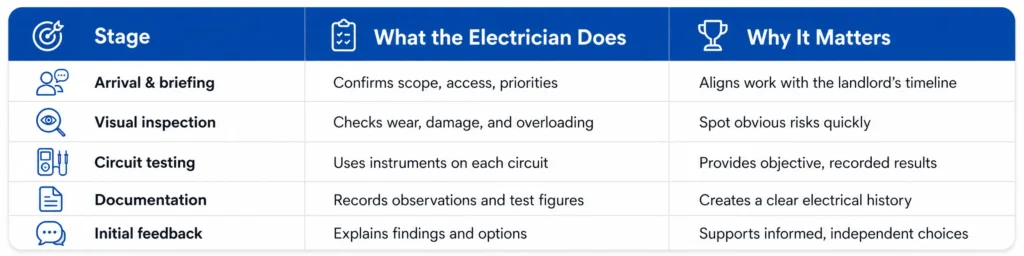
A same-day EICR inspection in London follows a structured process designed to gather accurate test results without dragging into the next day. The electrician arrives with calibrated test equipment, confirms access to all rooms, and briefly walks through the property with the landlord or agent to clarify expectations and any known issues.
Power may be isolated in sections so circuits can be tested safely without unnecessary downtime. Visual checks come first, followed by dead testing, live testing, and verification of earthing and bonding. Any immediate hazards are highlighted on the spot so the landlord can decide how quickly to act.
How a Valid EICR Certificate Protects Tenants
Even before the report reaches the landlord’s inbox, a valid EICR directly safeguards tenants by verifying that the electrical installation is fundamentally safe to use. It acts as an independent check on the fabric of the system that powers a tenant’s lifestyle, helping guarantee people can live, work, and relax without constant concern about hidden electrical hazards.
A current, satisfactory EICR supports tenant safety and autonomy in several concrete ways:
- Reduces fire and shock risks by identifying defects, overloaded circuits, and damaged cabling before they escalate.
- Confirms that life-saving devices, such as RCD and bonding, are present and working, providing tenants with a safety net when something goes wrong.
- Creates traceable accountability, documenting that an electrician has tested, measured, and verified the installation against recognised standards.
- Empowers informed choices, allowing tenants to question outdated or absent reports and insist on safe conditions as a non‑negotiable baseline.

Next Steps After Getting Your EICR Certificate
Receiving an EICR certificate is not the end of the process but the trigger for clear, practical decisions. Once the report is in hand, a landlord reviews every observation, noting which items are “satisfactory” and which carry codes such as C1, C2, or FI. These indicate urgent or investigative actions that cannot be ignored if they wish to keep tenants and themselves free from risk and legal pressure.
Corrective work should then be scheduled promptly with a qualified electrician, with written quotes and timelines agreed in advance. After remedial work, an updated EICR or minor works certificate should be obtained and stored.
| Emotion | Risk if Ignored | Freedom When Resolved |
| Fear | Fire, shock | Peace of mind |
| Stress | Legal penalties | Confident compliance |
| Doubt | Voided insurance | Trust in the property |
Frequently Asked Questions
How Much Does a Same Day EICR Certificate Typically Cost in London?
Same-day EICR certificates in London typically cost £150–£300, depending on property size, urgency, and electrician availability. Freedom-seeking landlords often compare fixed quotes, confirm what’s included, and avoid suspiciously cheap offers that may compromise thorough, honest inspection standards.
Can I Use One EICR Certificate for Multiple Rental Properties I Own?
No, a single EICR cannot lawfully cover multiple rentals; each property needs its own report. Every address has unique circuits, loads, and risks, so separate inspections, documentation, and renewal dates protect both landlord autonomy and tenant safety.
How Often Must Landlords Renew an EICR Certificate Under Current UK Regulations?
Landlords must renew an EICR at least every five years, or sooner if the report specifies. A new EICR is also required at the change of tenancy for safety assurance, even when freedom-loving landlords prefer minimal interference.
Does My Landlord Insurance Require a Valid EICR to Remain Valid?
Their insurance may require a valid EICR; it depends on the specific policy wording. Many insurers insist on current electrical safety evidence. They should read the policy schedule and conditions, or confirm in writing with the insurer or broker.
Are EICR Certificates Different for HMOS Compared With Single-Let Properties?
Yes. For HMOs, EICR requirements are typically stricter and more frequently enforced, often tied to licensing. At the same time, single-lets usually follow standard five‑year inspection rules, with fewer additional conditions, but still need full compliance.
Conclusion
By acting quickly to secure a same-day EICR certificate in London, landlords protect their tenants, their properties, and their legal standing. Understanding codes such as C1, C2, and C3, preparing the property in advance, and choosing a qualified, responsive electrician all help ensure the process runs smoothly. With a valid EICR in hand, landlords gain clear evidence of safety, a plan for any necessary remedial work, and confidence that their electrical systems comply with current regulations.