


How to read a gas safety certificate? A UK Gas Safety Certificate sets out key safety information in a clear layout. It first confirms the property address and the Gas Safe engineer’s name, registration number, and signature. It then lists each appliance and flue, with test results, defects, and any required remedial actions. Dates show when the check was done, when the record was issued, and when the next check is due. The engineer’s declaration confirms legal compliance, and each section has a specific role to understand.
Key Takeaways
- Check property and engineer details first to confirm the certificate relates to your address and a valid Gas Safe registered engineer.
- Review the appliance list to see which boilers, fires, and cookers were inspected, including their locations and individual safety outcomes.
- Examine flue and safety check results, focusing on gas tightness tests, combustion readings, and any noted defects or advisories.
- Note the inspection date, issue date, and next due date to understand how current the safety evidence is and when renewal is required.
- Confirm the engineer’s declaration, signature, and registration number, which legally anchors responsibility and validates the inspection’s compliance with gas safety regulations.
Table of Contents
Understanding the Gas Safety Certificate Layout
A UK gas safety certificate follows a standardised layout that groups essential information into clearly defined sections, making it easier to check compliance at a glance. This structure allows a landlord or tenant to move quickly through the document, seeing what actually matters without getting lost in technical clutter.
The layout typically progresses from broad legal essentials through to practical details about the gas installation and its condition. Headings, tables, and numbered entries guide the eye, so a reader can immediately distinguish mandatory safety data from ancillary notes. Clear separation of sections reduces dependence on an intermediary and lets anyone track whether the certificate meaningfully proves that checks were carried out.
Most certificates use consistent visual cues: bold subheadings, boxed areas, and tabular lists. These make it straightforward to compare one certificate with another, identify missing elements, and spot where further questions or follow‑up work might be required.

Checking Property and Engineer Information
When reading a UK Gas Safety Certificate, the first checks should be the property details listed on the Gas Safety Record to guarantee they match the actual address and premises. The reader should then confirm the Gas Safe engineer’s information, including their name, Gas Safe registration number, and company details. Together, these sections help verify that the inspection was carried out by a qualified professional at the correct property.
Property Details on the Gas Safety Record
Clarity begins with correctly matching the certificate to the right property and engineer. On a UK Gas Safety Record, the property section anchors the document to a real, lawful space, not just a name on a tenancy agreement. Readers should confirm the full address, postcode, and, where used, flat or unit number. Any error here weakens the record’s value and can complicate disputes or insurance claims.
The certificate may also note the type of property (house, flat, HMO) and, where relevant, the landlord or managing agent’s details. This helps prove who is responsible for safety. By checking these entries precisely, a tenant or owner protects their ability to act freely—whether that means challenging poor compliance or confidently moving tenants in.
Gas Safe Engineer Details
Once the property details are confirmed, attention should move to the person who carried out the work: the Gas Safe registered engineer. On the certificate, their name, Gas Safe registration number, and company details should be clearly printed and legible. The registration number can be checked against the official Gas Safe Register to confirm they are currently licensed and appropriately qualified for the appliance types listed.
The engineer’s signature and the date of the safety check are equally important, proving who took responsibility and exactly when. Here is the blog post for Choosing a Gas Safe Registered Engineer: How to Find the Right Professional
Any mismatch between engineer details and the Gas Safe Register should trigger questions before anyone feels comfortable relying on the record.
- Peace of mind to live without hidden risks
- Confidence to question anything unclear
- Freedom to walk away from unsafe arrangements
Reading Appliance and Flue Details
When reading the appliance and flue section, the certificate lists each gas appliance by type and location within the property. This helps confirm exactly which boilers, fires, cookers, or heaters have been assessed and where they are installed. It also summarises key flue and safety check information, indicating whether each appliance safely removes combustion products and meets required standards.
Appliance Type and Location
Clear appliance descriptions help the reader see, at a glance, how gas use is spread through the home or rental, supporting informed choices about upgrades, replacements, or removals that suit a flexible lifestyle.
- A visible map of gas appliances that supports independent decision‑making
- Confidence that no hidden corners of the property are ignored
- Space to plan changes without guesswork or limitation
Flue and Safety Check Information
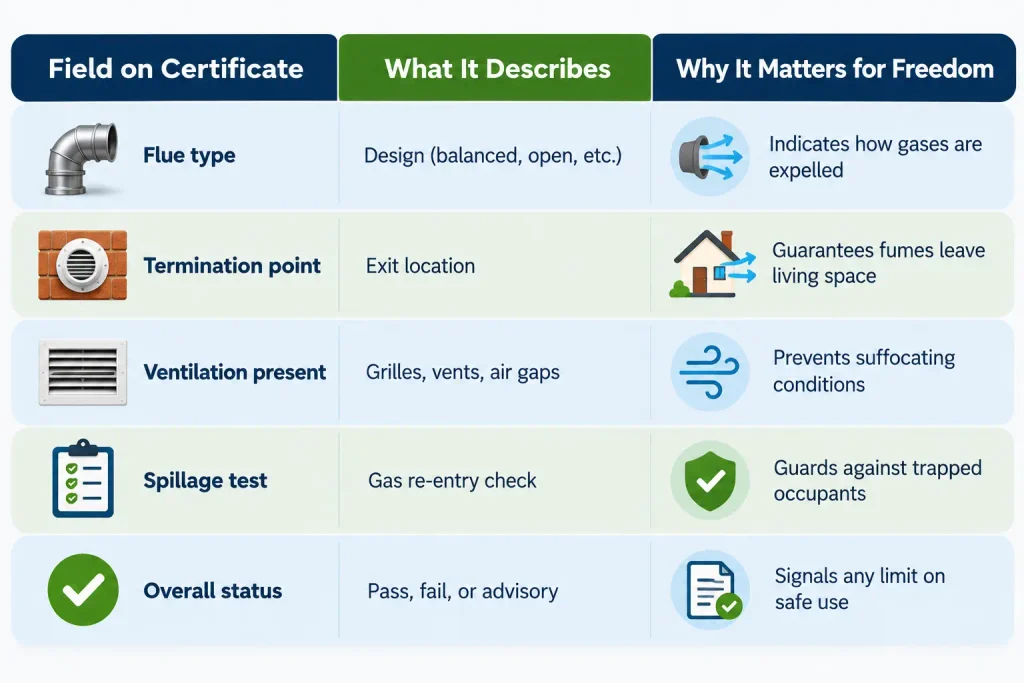
Most gas safety certificates devote a specific section to flue and safety check information, and this is where the real health protections can be seen in writing. In this part, a reader can verify that combustion gases leave the property safely, allowing them to live and move without hidden risk. The engineer records visual checks, test results, and whether any ventilation or flue routes are obstructed.
Look for Safety Check Results
When examining the safety check results, the reader should focus on the gas tightness test and individual appliance test outcomes, which confirm whether the system is leak-free and operating safely. They should also note any recorded defects or advisories, as these highlight issues that may affect safety now or in the near future. Finally, attention should be given to any specified remedial actions, indicating what work is required to bring the installation up to standard.
Gas Tightness and Appliance Test Results
Gas safety hinges on the tightness of the pipework and the performance of each connected appliance, and the certificate records both in a dedicated test results section. This part shows whether the system can hold gas under pressure without leaking and whether each boiler, hob, or fire operates within safe limits.
Engineers usually note test pressures, permissible pressure drops, and whether the tightness test is “pass” or “fail.” Appliance results then confirm correct burner pressure, gas rate, and flame picture, along with safe operation of safety devices.
Readers who value independence can see, at a glance, whether the system is sound enough to trust.
- A sealed system that respects their right to breathe clean air
- Appliances burning cleanly, without hidden risk
- Evidence that risk is checked, not assumed
Defects, Advisories and Remedial Actions
Although the technical figures matter, the safety check results section is where the certificate speaks in plain language about risk. Here, defects, advisories and remedial actions translate numbers into clear consequences that directly affect how freely someone can live in their home.
Defects highlight what is unsafe now: labels such as “Immediately Dangerous (ID)” or “At Risk (AR)” mean an installer may cap the supply or isolate an appliance to protect life. Advisories flag emerging issues that do not yet restrict use but demand planning.
Remedial actions show the route back to safe, unrestricted operation, outlining repairs, replacements or adjustments required. A freedom‑minded reader checks that actions are specific, time‑bound and linked to each recorded fault.
Checking Dates and Certificate Information
A crucial step in reviewing a UK Gas Safety Certificate is confirming the accuracy of its dates and core identifying details. This information anchors the document in time and place, making it possible to prove that legal duties have been met without unnecessary constraint or confusion. Readers should first verify the certificate number, the property address, and the name of the duty holder, ensuring they match tenancy agreements or ownership records.
The engineer’s Gas Safe registration number and business details must appear clearly and legibly. These act as a traceable link to competent work, protecting the occupier’s right to live without hidden risk. Any inconsistencies can be challenged, corrected, or used to question the validity of the assessment.
- Feel secure knowing the paperwork truly reflects the home they live in
- Avoid dependence on unclear or incomplete records
- Stand firm when demanding safe, lawful gas work
Inspection Date and Record Issue Date
Timing on a UK Gas Safety Certificate hinges on two key entries: the inspection date and the record issue date. The inspection date marks when the engineer actually examined the gas appliances, flues, and pipework. It anchors the factual condition of the system in time: what was seen, tested, and confirmed safe (or unsafe) on that specific visit.
The record issue date is when the engineer formally completed and released the certificate. It may be the same as the inspection date or a little later, for example when administrative checks or report compilation take longer. For someone who values flexibility and control over their living space, distinguishing these dates helps them challenge delays, query outdated paperwork, or prove that a check occurred before a particular event. Reading both dates together lets a tenant or landlord assess how current the safety evidence really is, rather than accepting paperwork at face value.
Next Gas Safety Check Due Date
When is the next gas safety visit actually required, and how is that shown on the certificate? On a UK Gas Safety Certificate, this appears as the “Next Gas Safety Check Due Date” or similar wording. It tells the responsible person the latest date by which the next check must be completed, usually no more than 12 months after the last safety check. For landlords, this date anchors legal compliance, but it also frames a predictable rhythm of maintenance. Explore How Often Should Landlords Arrange Gas Safety Checks? Understanding the 12-Month Rule
This section helps someone plan ahead rather than react to emergencies. Reading it correctly means they can book an engineer in advance, maintain uninterrupted use of the property, and stay firmly in control of their time.
- A clear due date preserves autonomy over when work happens.
- Forward planning avoids last‑minute pressure from agents, tenants, or authorities.
- Knowing the limit empowers proactive decisions instead of forced reactions.
Understanding Engineer Declaration and Sign-Off
Beyond the date of the next visit, the certificate also contains the engineer’s declaration and sign-off, which confirms who carried out the work and on what authority. This section names the Gas Safe registered engineer, their registration number, and often the company details. It anchors responsibility, making clear who is accountable for the inspection and any judgments recorded.
The declaration normally states that the appliances and flues have been checked in line with current gas safety regulations and relevant standards. The engineer signs and dates this statement, turning a checklist into a formal, legal assurance.
For anyone who values control over their space, this is the proof that the inspection was not casual or unofficial. It allows the reader to verify the engineer on the Gas Safe Register, challenge poor work, and insist on competent service that doesn’t compromise safety, comfort, or the right to use their property freely.
Frequently Asked Questions
Is a Digital Copy of the Gas Safety Certificate Legally Acceptable?
Yes, a digital copy is generally legally acceptable if it’s clear, complete, and accessible. The law requires valid records, not paper. Tenants, landlords, and authorities only need reliable proof the safety check was properly completed.
How Long Must Landlords Keep Previous Gas Safety Records?
Landlords must legally keep gas safety records for at least two years. They should also guarantee each new certificate is kept until two further checks have been completed, preserving a continuous paper or digital trail of accountability.
What Should I Do if My Landlord Won’T Provide a Certificate?
They should first request the certificate in writing, then contact the local council or Health and Safety Executive. They may also withhold consent to new tenancies, seek legal advice, or report unsafe conditions immediately.
Does a Gas Safety Certificate Affect My Home Insurance Cover?
Yes, it can. Insurers often require valid gas safety records for rental properties; without one, claims related to gas appliances may be rejected, premiums altered, or cover cancelled, limiting the occupier’s autonomy after an incident.
Are Gas Safety Certificates Required for Short‑Term Holiday Rentals Like Airbnb?
Yes. For UK short‑term lets, including Airbnb, landlords must hold a valid annual Gas Safety Certificate where gas appliances exist. Guests aren’t usually asked to see it, but hosts must keep records and meet legal safety duties.
Conclusion
To conclude, “How to read a gas safety certificate” A gas safety certificate becomes far less intimidating once each section is understood. By checking property and engineer details, reviewing appliance and flue information, and confirming safety check outcomes, anyone can quickly gauge a property’s gas safety status. Noting the inspection and next due dates helps guarantee timely renewals, while the engineer’s declaration confirms accountability and competence. Together, these elements provide clear reassurance that gas installations have been professionally assessed.